
For most Irish families, the paper trail runs out before civil registration of births, marriages and deaths began (1864 for Catholics). Beyond that point, the records that keep your research alive are almost always the Catholic parish registers — the baptism and marriage books kept by individual parishes, many stretching back to the early 1800s and some further still.
The catch is that these registers are organised by parish, and Catholic parishes don’t line up neatly with the civil parishes and townlands you may already know. Our Catholic Parishes tool bridges that gap.
Over a thousand parishes on one map
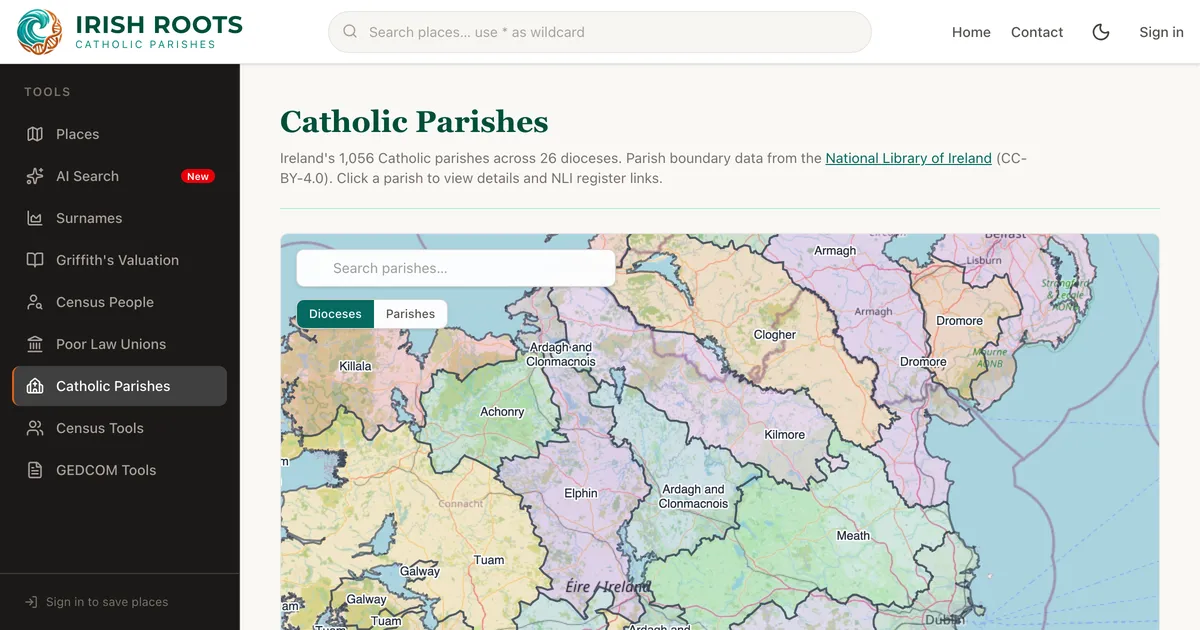
The tool maps more than 1,000 Catholic parishes across every diocese in Ireland. You can search for a parish by name or explore the map directly, clicking into any parish to see its details. The boundary data comes from the National Library of Ireland and is published under a CC-BY-4.0 licence.
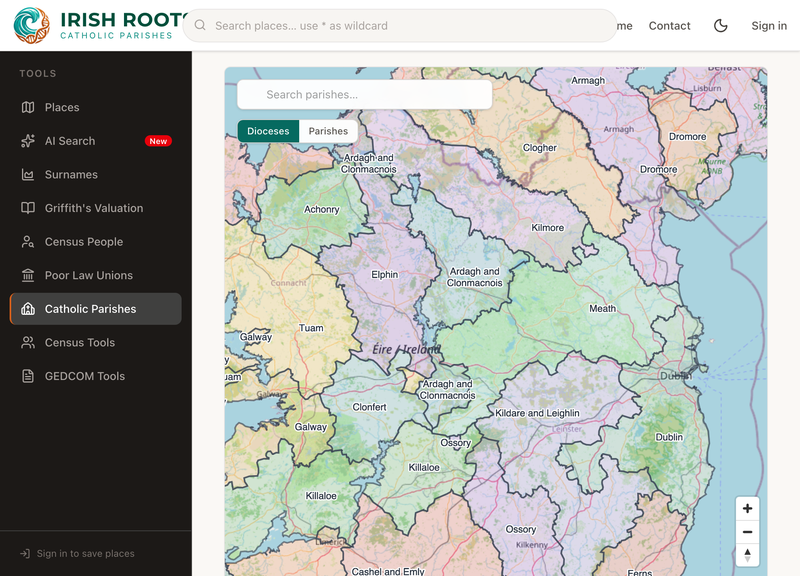
Over 1,000 Catholic parishes mapped across every diocese in Ireland.
Straight to the registers
This is the part that saves real time. When you open a parish, the tool provides direct links to the National Library of Ireland’s digitised registers for that parish. The NLI has photographed the Catholic registers for the whole island and made them free to view — but finding the right parish’s films can be fiddly. Here, the link is right there next to the parish on the map.
Which townlands belong to the parish?
Because Catholic and civil boundaries differ, one of the most common questions is simply: which townlands does this parish actually cover? The tool answers it directly — open a parish and you can see the townlands that fall within it. That lets you work confidently from a townland you found in Griffith’s Valuation or the census to the correct register to search next.
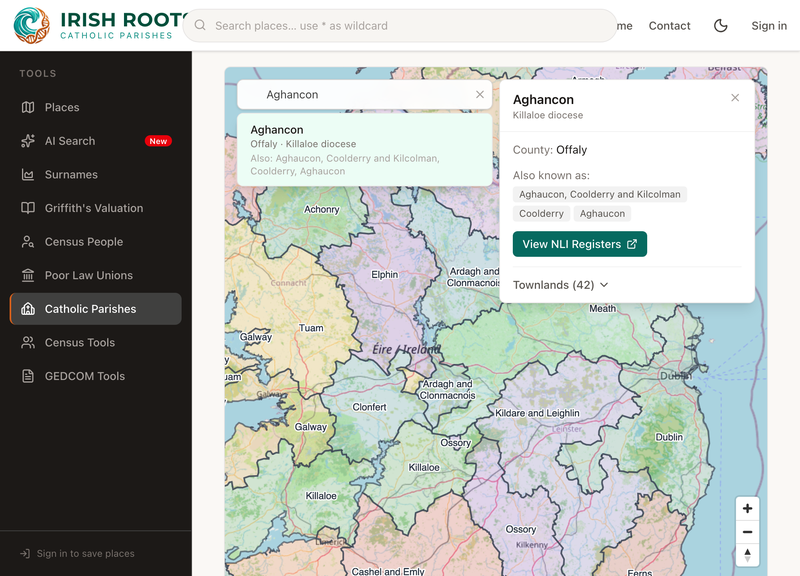
Open a parish to see its townlands and a direct link to the National Library of Ireland registers.
Find the right parish, and you’ve found the book your ancestors were written into.
Irish Roots
A practical workflow
Start with a place you already know — a townland from the census or Griffith’s Valuation. Find which Catholic parish it belongs to here, open the NLI register link, and search the baptism and marriage records for the years you need. It is the single most reliable way to push an Irish line back past the mid-nineteenth century.