
Most people researching Irish ancestry hit the same wall. You trace a family back through the 1901 and 1911 censuses, perhaps back further through Griffith’s Valuation in the 1850s, and then the trail simply stops. The nineteenth-century censuses that would carry you further back are gone — the 1821 to 1851 returns almost entirely destroyed in the 1922 Four Courts fire, the 1861 to 1891 returns deliberately pulped years earlier.
The Tithe Applotment Books are one of the very few records that reach back past that wall. Compiled between 1823 and 1837, they name ordinary people — farmers, smallholders, widows — in the years before the Great Famine changed Ireland permanently.
What are the Tithe Applotment Books?
They exist because of a tax, and an unpopular one.
Until the nineteenth century, tithes were paid to the Church of Ireland — the established church — in kind. A tenth of your produce: grain, potatoes, livestock. Everyone who worked the land paid, regardless of their own religion, which meant the Catholic majority and Presbyterian communities were supporting a church they did not attend. It was resented for exactly as long as it existed, and in the 1830s that resentment boiled over into the years of unrest known as the Tithe War.
The Tithe Composition Act of 1823 changed how the tax was collected. Instead of taking a share of the harvest, tithes would now be paid in money. But to charge people in cash, somebody had to work out what each person owed — and that meant surveying every civil parish in the country, valuing the land, and apportioning the tithe among the people who occupied it.
That apportioning is the “applotment”. The books that record it, parish by parish and townland by townland, are what survive today.
Why they matter to family historians
Their value is simple: they put a named person in a named townland at a known moment, roughly two decades before the Famine.
That timing is everything. The Ireland recorded in these books — its population approaching eight million, its countryside densely settled — was about to be transformed by starvation and mass emigration. Many of the people named in the Tithe Books did not survive the following decade. Many of their children left and never came back. For families in America, Canada, Australia and beyond, these books often name the last generation to live in the townland the family came from.
What the books do not cover
It is worth being honest about the gaps, because they matter.
Only agricultural land was tithed. Towns and cities are therefore poorly represented, and where urban holdings do appear they are often recorded by street rather than by townland. Landless labourers and cottiers — a very large share of the pre-Famine population — frequently held no tithe-liable land at all, and so were never written down. And the books record the occupier of a holding, usually the head of a household, not every person living under the roof.
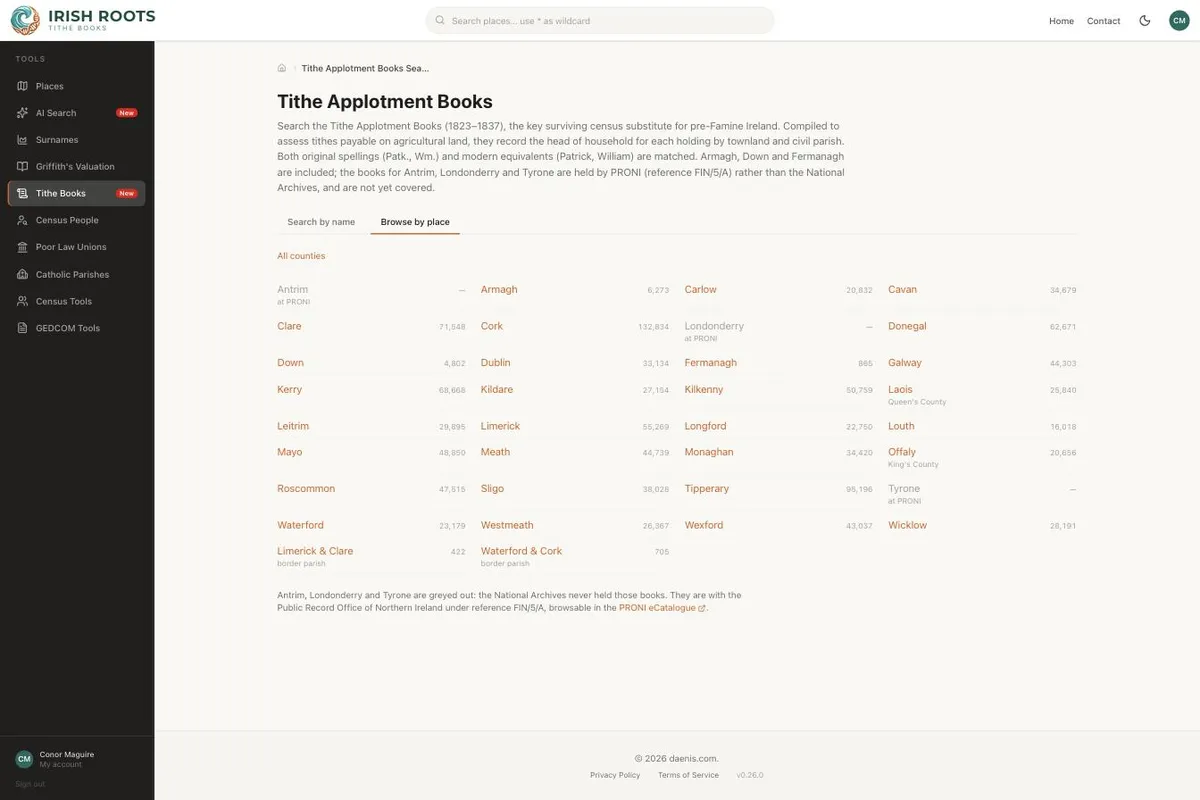
Nor are they complete geographically. The National Archives of Ireland holds the books for 29 of Ireland’s 32 counties. Those for Antrim, Londonderry and Tyrone are held by the Public Record Office of Northern Ireland instead, under reference FIN/5/A, and are not included in our index. Armagh, Down and Fermanagh are included.
None of this makes the books less valuable. It just means an absence is not proof that a family was not there.
Searching the books on Irish Roots
Our index covers around 700,000 entries across those 29 counties, and it is free to search. There are two ways in, depending on what you already know.
If you know a name
Search by surname, or by full name to narrow things down, and filter by county and civil parish. The search handles a problem that trips up a lot of people: nineteenth-century clerks abbreviated constantly. “Patrick” is written “Patk.”, “William” becomes “Wm.”, “Michael” becomes “Michl.” Search the modern spelling and you will find those abbreviated entries too, without having to guess which form the clerk used.
Spelling of surnames was equally loose, so the search also matches names that sound alike — useful when the same family appears as Maguire, McGuire and Magwire across three pages.
If you know a place
The Browse by place tab works the way the original records do: start with a county, then a civil parish, then a townland, and read everyone recorded there. This is often the more revealing approach. Seeing every household in a small townland tells you who your ancestors lived beside, which surnames dominated the place, and who they were likely related to or married into.
Counties appear under their modern names, with the pre-1922 name shown alongside — Laois as Queen’s County, Offaly as King’s County — because that is how the original books label them.
A note on townland names
If you search for a townland and find nothing, the name is often the reason.
The men who compiled these books in the 1820s and 1830s were writing down Irish place names, usually by ear, usually in English, and long before anyone had settled on a standard spelling. The results can be startling. Abbeyleix in County Laois appears in one book as Ableeylux. Elsewhere the same place is written two or three different ways within a handful of pages. Names are inverted — Upper Dunloe for what is now Dunloe Upper. Many entries carry two names at once, in the form Ballybeg or Littleton, because the townland was genuinely known by both.
We are working through this. Where we can confidently identify the modern townland behind an old spelling, we link the record to it, so it appears on that townland’s page alongside Griffith’s Valuation and the census. That matching is an ongoing exercise rather than a finished one, and we would rather leave a record unlinked than attach it to the wrong place. If you find an entry that is clearly mismatched, or a spelling we have missed, please tell us — corrections from people who know their own townland are worth more than any algorithm.
A practical tip in the meantime: if a name search comes up empty, browse to the civil parish instead and read down the list of townlands. Your eye will recognise a mangled spelling far faster than a search box will.
Some townlands may be incomplete
We should be straight about one thing. The National Archives’ tithe site has been offline since July 2026, and our index was rebuilt from the copies the Internet Archive saved. Those copies don’t cover every page, so some townlands, mostly the larger ones, may be missing entries.
If you find your family, treat that as solid. If you don’t, it doesn’t mean they weren’t there.
The original pages
Every record links to a scan of the handwritten page it came from. Transcriptions are enormously useful, but they are also interpretations of difficult handwriting, and there is no substitute for looking at the original. The page will also show you the neighbouring entries, the surveyor’s notes, and the shape of the document itself — things no index can capture.
Following a surname across the country
The Tithe Books also feed our Name Distribution map, which shows where a surname clustered in the 1820s and 1830s. Comparing that against the same surname in Griffith’s Valuation two decades later, or in the 1901 census seventy years later, can show a family holding its ground, spreading out, or disappearing from a district entirely.
An absence in these books is not proof a family was not there. But a presence is proof that they were — in that townland, in that parish, before the Famine.
Irish Roots
Where to start
If you already have a townland from Griffith’s Valuation or a census return, start there and work backwards: look up the same townland in the Tithe Books and see whether the surname was present twenty or thirty years earlier. If all you have is a surname and a county, start with the name search and let the geography suggest where to look more closely.
Every townland page on the site now carries a Tithe Applotment Books tab alongside its Griffith’s Valuation and census records, so you can move between all three without losing your place.