
On the night of 18 April 1926, every household in the Irish Free State filled in a census form. It was the first census taken by the new state, and for a hundred years the returns stayed closed. In April 2026 the National Archives of Ireland opened them to the public.
The 1926 census is now part of Irish Roots, alongside the 1901 and 1911 censuses, Griffith’s Valuation and the Tithe Books. It sits on the same townland pages and in the same searches, so you can follow a family from 1901 to 1926 without leaving the site.
Why 1926 matters
For most Irish families the 1911 census has been the last full picture before living memory. A great deal happened in the fifteen years after it: the First World War, the 1918 flu, the War of Independence, partition and the Civil War, and steady emigration throughout.
The 1926 census shows who was still there afterwards. It names the grandparents and great-grandparents many people remember, or remember being told about. Where 1911 might show a couple with young children, 1926 shows those children grown, married and heads of their own households, often in the same townland.
What the forms record
For each person the transcription gives:
- name, age and sex
- relationship to the head of the household
- religion
- county or country of birth
- whether they spoke Irish
- marital status and, for married women, years married and children born and still living
One question was new in 1926. For children under 15 the form asked whether their father and mother were alive. Coming after a decade of war and the flu, the answers can be striking, and they often point to a death worth looking for in the civil records.
The form also asked about occupation and employment, but the National Archives has not transcribed those columns. They are on the original form, so open the image to read them.
What it does not cover
The 1926 census covers the 26 counties of the Irish Free State. Antrim, Armagh, Down, Fermanagh, Londonderry and Tyrone are not in it, so for families there the 1911 census is still the latest one on the site.
Searching 1926 on Irish Roots
By name
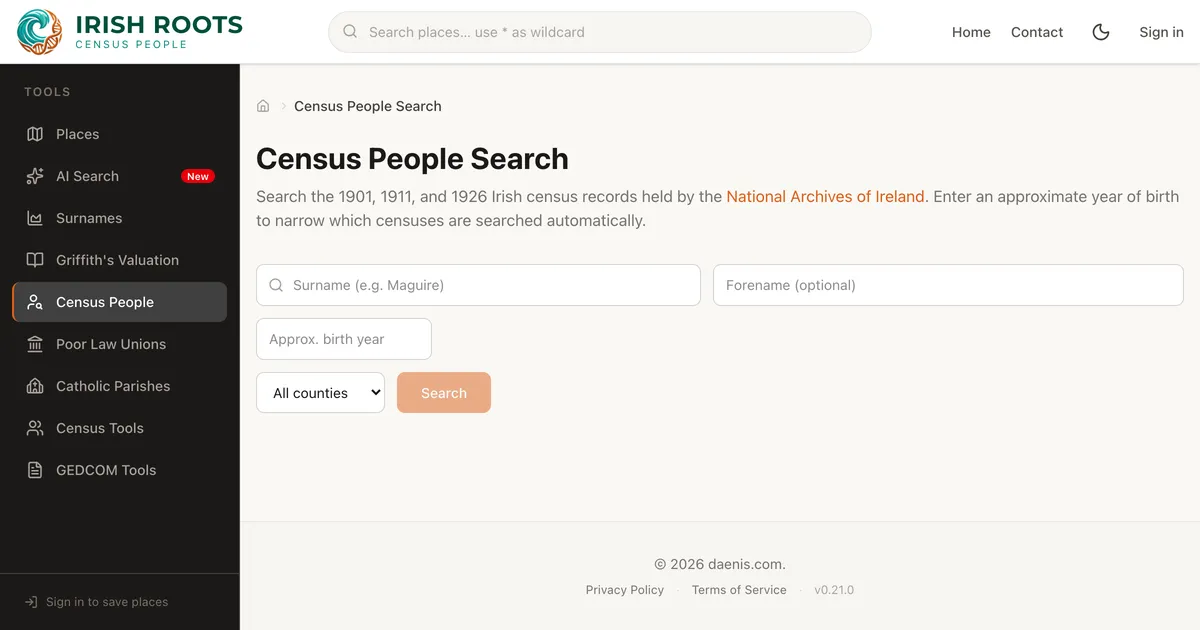
The census search now covers 1901, 1911 and 1926 together. Search a surname and it also finds the O’ and Mc/Mac forms, so Reilly finds O’Reilly as well. Add an approximate year of birth and the search picks the census years that person could appear in.
By household
Every 1926 household has its own page, listing everyone on the form with their ages, relationships and the rest of their details. It links to each person and to their townland.
By place
Townland pages now carry the 1926 census beside 1901 and 1911, so you can see who lived there at each census. We have linked about 60% of 1926 households to their modern townland so far. The rest were written in spellings we can’t yet match with confidence. They still turn up in name searches, and we’ll keep adding links.
The original forms
Every 1926 household links to scans of the original forms at the National Archives: the household return (Form A), in the family’s own handwriting, and the enumerator’s house return (Form B1). The forms hold what no transcription can, including the occupations, the handwriting and sometimes a note in the margin. Each household page also gives the archival reference, so you can cite the record properly.
Surnames in 1926
The 1926 census also feeds the surname map and the surname pages, which now show where a name was found from the Tithe Books in the 1820s through to 1926. Comparing 1911 with 1926 for the same surname can show a family spreading out, moving to the towns or thinning out through emigration.
Free, and staying free
The National Archives released the 1926 census for anyone to reuse, and we’re keeping it that way. Searching, reading and linking to 1926 records on Irish Roots is free, and it won’t go behind a paywall.
Where to start
If you already know where the family was in 1911, open that townland and look at the 1926 tab to see who was still there. If all you have is a name and a county, search the name and read the households it finds.
This work includes content from records of the 1926 Census of Ireland, made available by the National Archives of Ireland under the Creative Commons Attribution 4.0 International (CC BY 4.0) licence. Please see further: Reuse of records of the 1926 Census. Licence: CC BY 4.0.
