
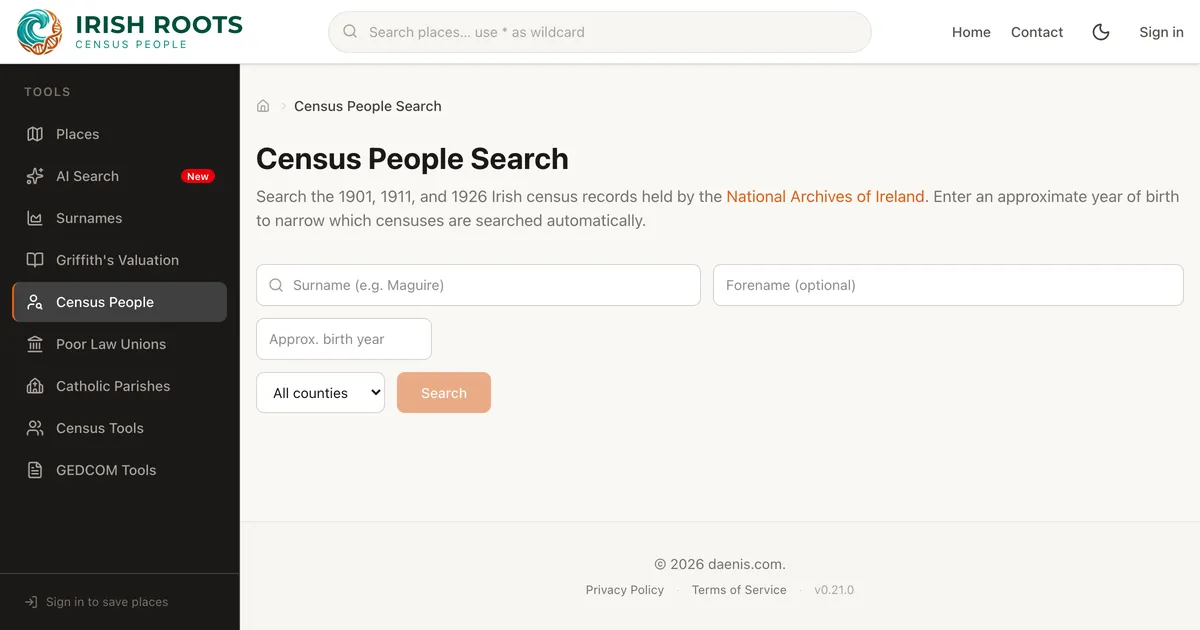
For all that Ireland lost of its nineteenth-century census, the returns that do survive are extraordinarily rich. The complete 1901 and 1911 census returns record every member of a household — names, ages, relationships, religion, occupation, literacy, and where each person was born. The 1926 census of the new Free State adds a further snapshot a generation on. Our Census People Search lets you search all three from one place.
One search, the right censuses
Enter a surname and forename to begin. The clever part is the approximate year of birth: give it, and the tool automatically works out which censuses could plausibly contain your ancestor and searches those — so you are not wading through decades of irrelevant returns. You can further narrow by county and even by a specific townland when you know it.
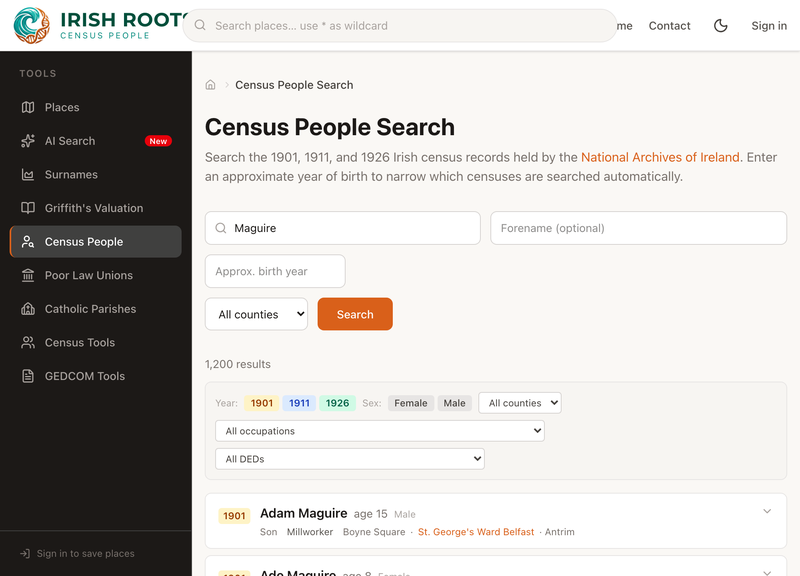
Search 1901, 1911 and 1926 together — an approximate year of birth picks the right censuses.
Straight from the National Archives
The records searched here are those held by the National Archives of Ireland, which digitised and published the 1901 and 1911 returns and, more recently, the 1926 census. Results link back to the authoritative record so you can read the full household return, see the enumerator’s original page, and confirm every detail for yourself.
Reading a household, not just a name
The real value of the census is context. Finding your great-grandfather is good; finding him aged 9, living with his parents and five siblings in a named townland, his father a “farmer” and the whole family recorded as Irish speakers — that is a story. Because the census records the entire household, a single search can populate a whole branch of your tree at once.
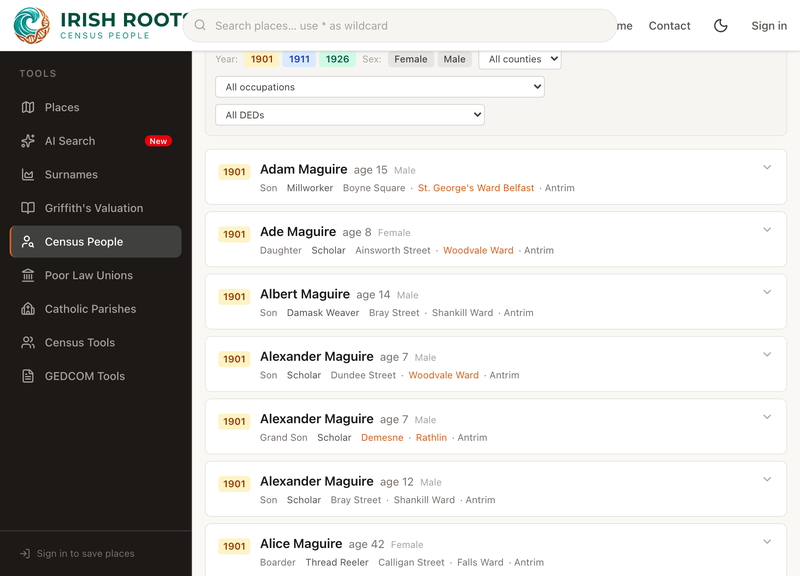
Results link straight to the full household return at the National Archives.
A census return doesn’t just confirm a name — it hands you a whole household.
Irish Roots
Tying it together
Once you have found a household, use the townland it names to branch out: check the same place in Griffith’s Valuation for the previous generation, find its Catholic parish to search the registers, and confirm its Poor Law Union for civil records. The census is often the doorway the rest of your research walks through.