
If you are researching Irish ancestors from the nineteenth century, Griffith’s Valuation is very likely the single most useful record set available to you. Because most of Ireland’s nineteenth-century census returns were destroyed — the 1821 to 1851 returns in the 1922 Public Record Office fire, and the 1861 to 1891 returns deliberately pulped — Griffith’s Valuation is treated by genealogists as the closest thing we have to a mid-century census of the whole island.
What is Griffith’s Valuation?
Officially the Primary Valuation of Ireland, Griffith’s Valuation was a property survey carried out county by county between 1848 and 1864 under Sir Richard Griffith. Its purpose was to determine how much each occupier of land and buildings should pay in local rates. To do that, it recorded the name of every head of household who occupied property, the name of the person they leased it from, a description of the holding, its acreage, and its rateable value — all tied to a specific townland.
For family historians, that means one thing above all: it places a named person in a named townland at a known point in time. For a country where the townland is the fundamental unit of belonging, that is gold.
Over a million searchable records
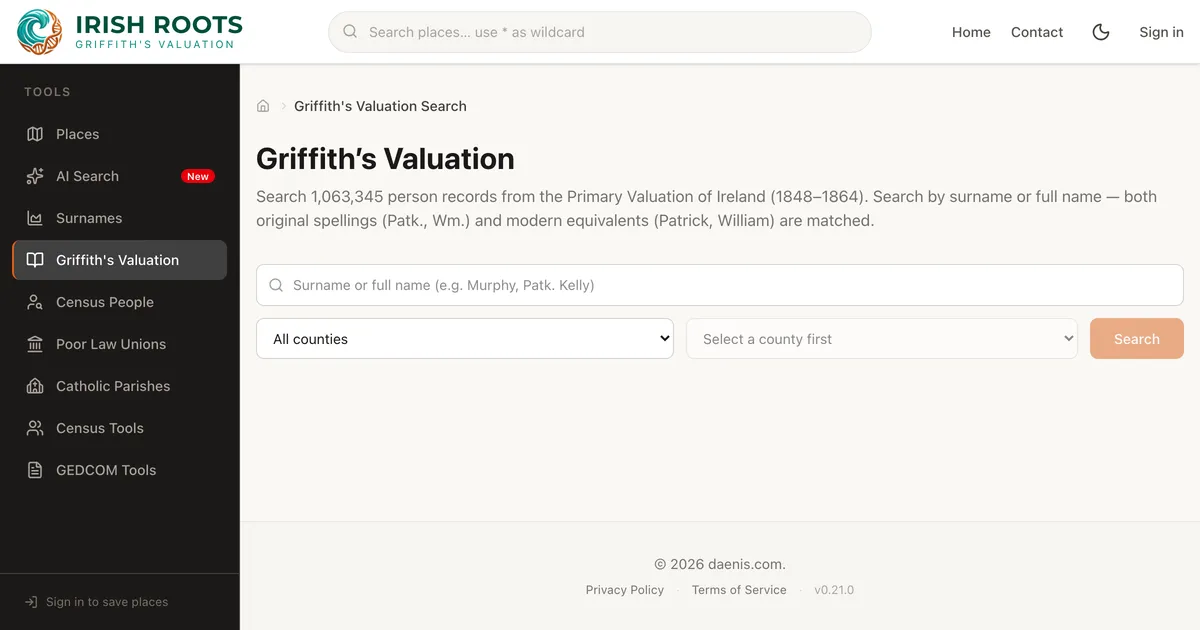
Our Griffith’s Valuation search covers 1,063,345 person records drawn from the printed valuation books. You can search by surname alone, or by full name to narrow things down. Every result links through to the townland it belongs to, so you can move straight from a name to its place in the wider administrative hierarchy — civil parish, barony, poor law union and county.
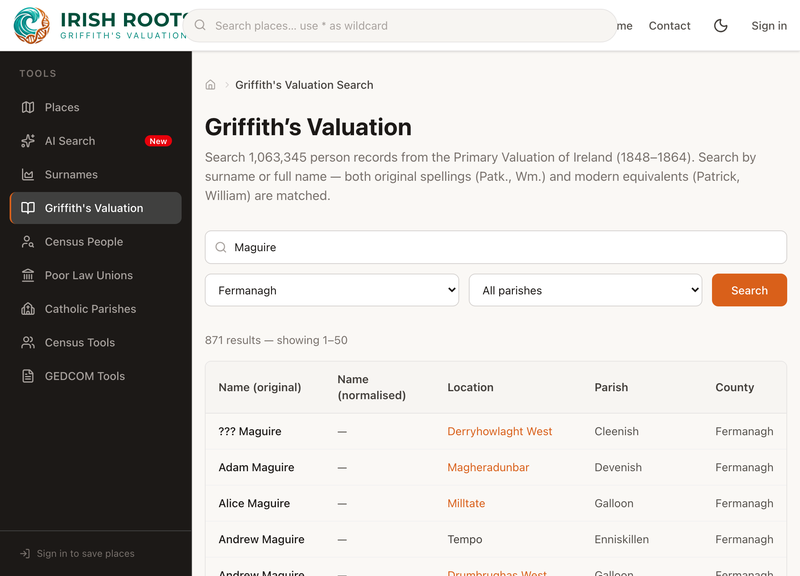
Searching Griffith's Valuation by surname, filtered to County Fermanagh.
It understands old spellings and new ones
Nineteenth-century clerks abbreviated relentlessly. “Patrick” became “Patk.”, “William” became “Wm.”, “Michael” became “Michl.” If you only search for the modern form, you will miss the record; if you only search for the abbreviation, you will miss the ones spelled out in full. Our search solves this by matching both the original abbreviations and their modern equivalents automatically. Search “Patrick” and you will also find “Patk.” without having to think about it.
Narrowing by county
Common surnames can return thousands of results. If you already know roughly where your family came from, use the county filter to cut the list down to the records that matter. If you don’t, the geographic spread of the results can itself be a clue — many Irish surnames were heavily concentrated in particular counties, and seeing where a name clusters is often the first step toward locating an ancestral townland.
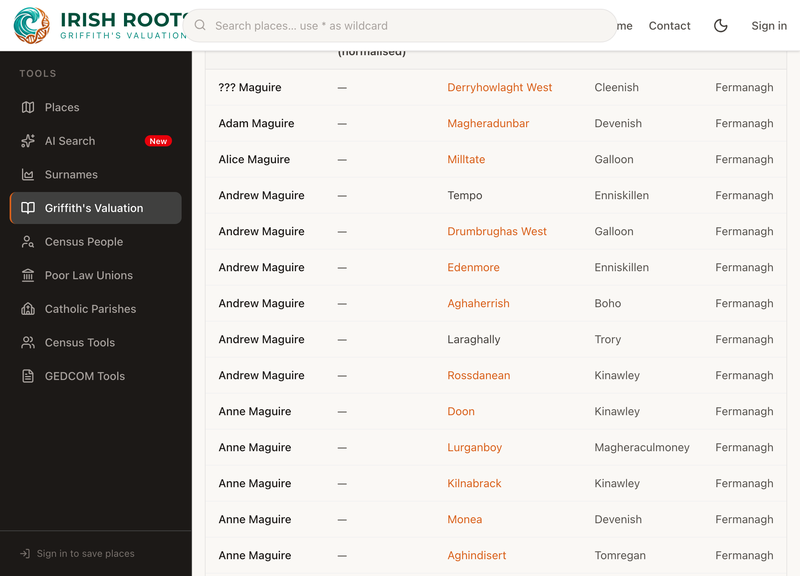
Every result links a named occupier to the townland where they held property.
Griffith’s Valuation is the bridge between a surname and a townland — and the townland is where Irish genealogy really begins.
Irish Roots
Where to go next
Once you have found a likely ancestor, click through to the townland record to see everyone else valued in the same place, explore the surrounding parishes, and cross-reference against the 1901 and 1911 census. If you would like to see how a surname is distributed across the whole country, our companion Name Distribution tool maps it for you.